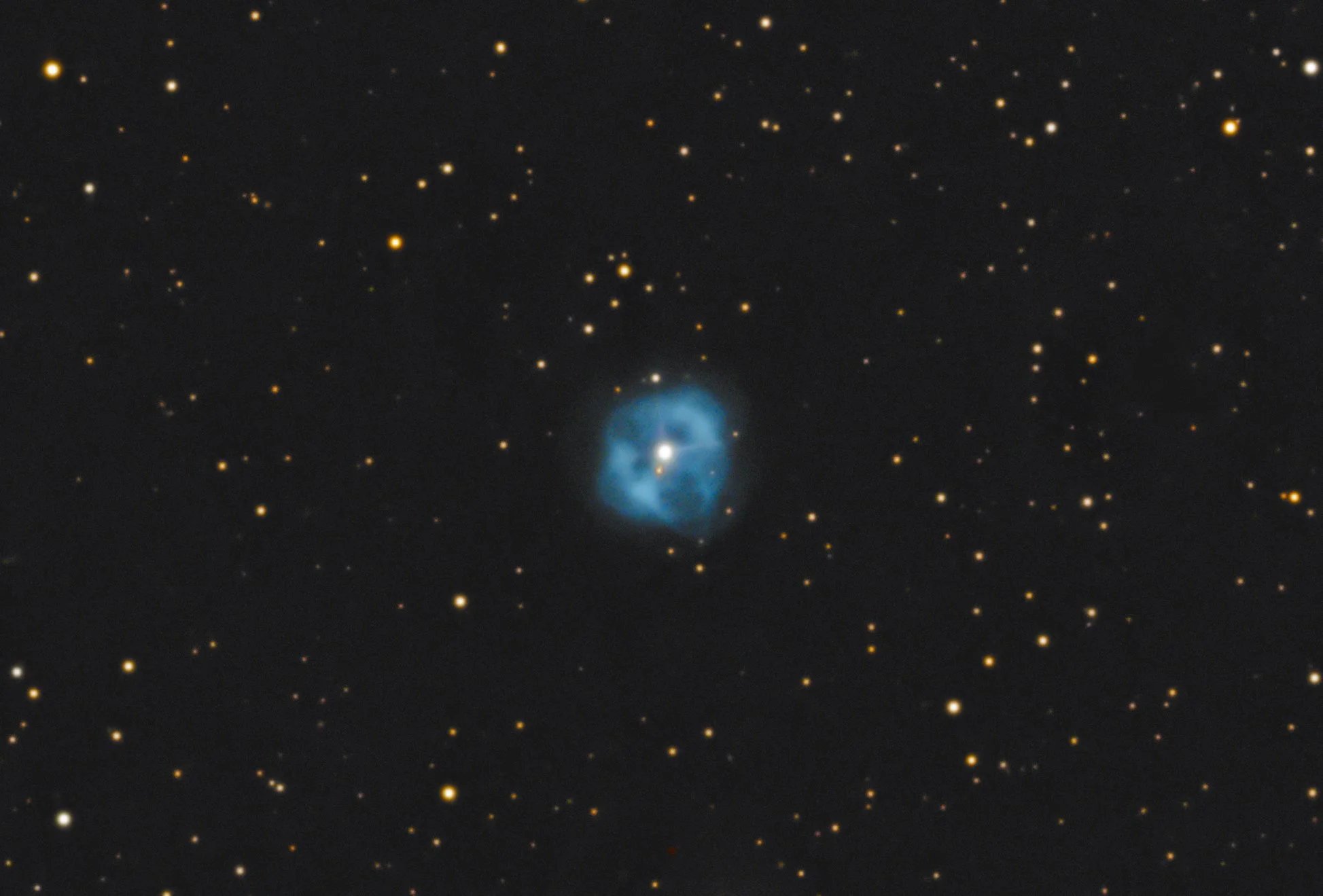
NGC 1514 is a planetary nebula lying 1,520 light-years from Earth in the constellation Taurus. While it may not look very impressive, it has tremendous historical significance. When William Herschel looked at the objects listed in Charles Messier’s catalogue with his 7 and 18-inch reflecting telescopes, he found that many of the objects Messier described as “nebula without stars” were composed entirely of stars or contained at least some stars. This caused him to formulate his theory that nebulous material didn’t exist at all in the heavens. Everything was composed of stars and any appearance of nebulosity was simply due to lack of adequate aperture and magnification to resolve it. That was until her found this object in November of 1781. He wrote that it was a most curious phenomenon. There was an 8th magnitude star centered within a nebulous atmosphere about 3’ in diameter. He wrote that thee was no doubt that the material was associated with the star and that the material could not be of a starry nature. That convinced him that true nebulosity did exist in the heavens and he subsequently referred to it as “luminous fluid”. I might never have bothered to image this planetary nebula, but once I knew of its historical influence on William Herschel’s theory of nebulosity, I had to.
Exposures: L:R:G:B = 130:65:65:65 minutes =1 hour 5 minutes 5 hours, 25 minutes total exposure, completely unguided.