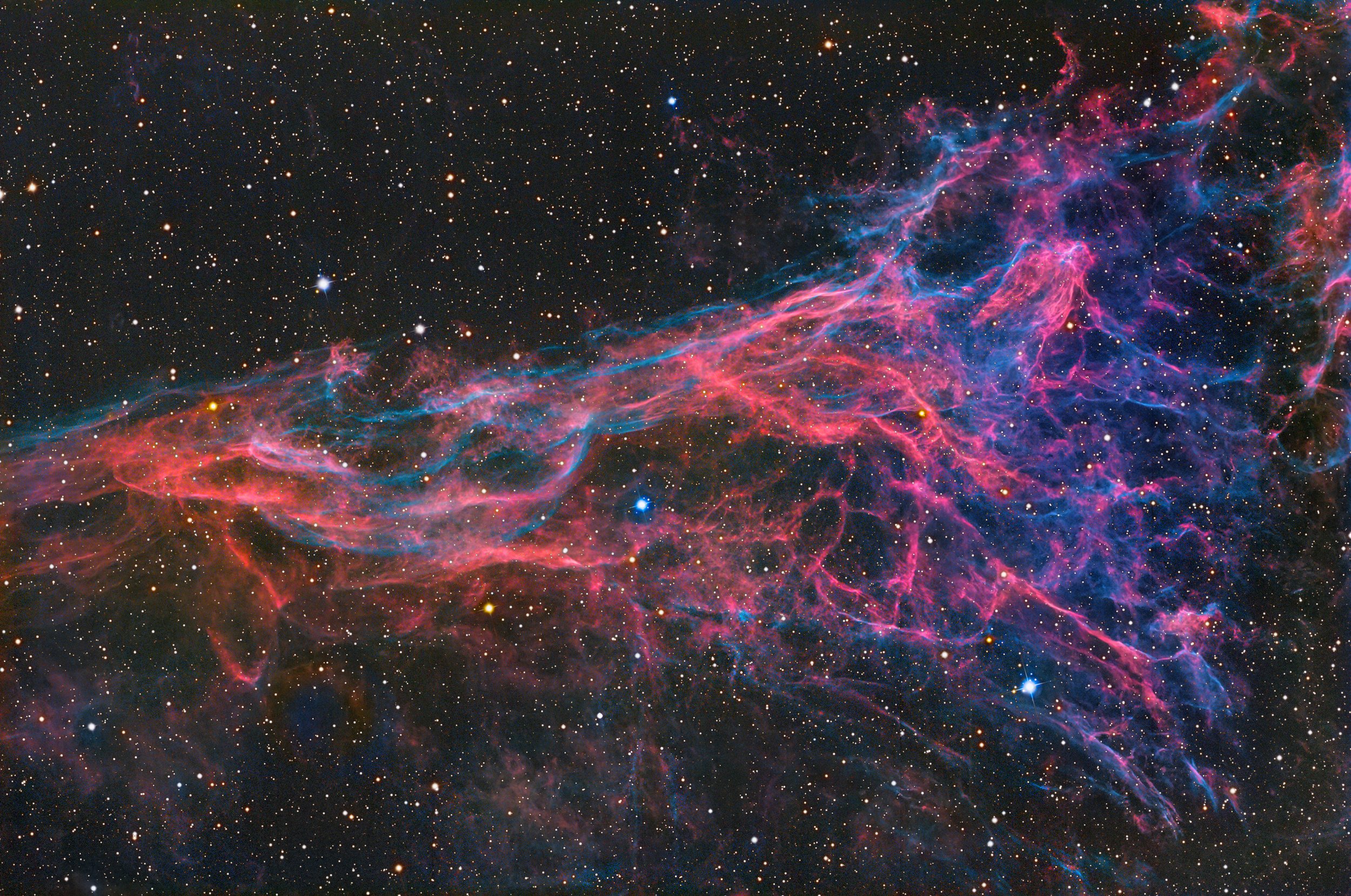
This object is formally known as Pickering’s Triangle, named after Edward Pickering, director of the Harvard College Observatory in the late 19th and early 20th centuries. It is part of the Cygnus Loop supernova remnant lying between the Veil and Witch’s Broom Nebulae. Edward Pickering was a progressive visionary for his time, employing over 80 women at the observatory, including several who made substantial contributions to astronomy, like Annie Jump Cannon, Antonia Maury, Celia Payne, and Willamina Fleming. This part of the supernova was actually discovered on a photographic plate by Willamina Fleming but, as was the custom of the time, the credit went to Pickering. Hence, I like to call it Picker-Flem-ing’s Triangle. Compare this image of it with the PlaneWave CDK 17 to the image of it with the Celestron Compustar C14 under Nebulae on this website. Again, the difference is jaw-dropping.
Exposures: Ha:R:G:B: = 660:200:200:200 = 21 hours total exposure, completely unguided.